
Your Custom Text Here
Your Placenta....It's What's Good for You!!
“You ate your what?!?!”
“Ewwww….that’s gross!! We’re not animals!”
“What are the benefits of doing that?”
“How do you eat it?”
“Do you have to have a home birth to do that?”
“How do I find someone to help me with it and what does it cost?”
These are the questions/statements I hear most often when people find out that not only do I encapsulate placentas, but that I ate my own! When people hear about placenta encapsulation, they usually react in one of several ways: 1) Curiosity, 2) Disgust, or 3) Fascination. I’m going to answer the questions that many people ask when they want to learn more, and then you can decide for yourself if placenta encapsulation is right for you!
“You ate your what?!?!”
“Ewwww….that’s gross!! We’re not animals!”
“What are the benefits of doing that?”
“How do you eat it?”
“Do you have to have a home birth to do that?”
“How do I find someone to help me with it and what does it cost?”
These are the questions/statements I hear most often when people find out that not only do I encapsulate placentas, but that I ate my own! When people hear about placenta encapsulation, they usually react in one of several ways: 1) Curiosity, 2) Disgust, or 3) Fascination. I’m going to answer the questions that many people ask when they want to learn more, and then you can decide for yourself if placenta encapsulation is right for you!
“You ate your what?!”
My placenta! It’s the organ that my body created specifically for the purpose of keeping my child alive and producing beneficial hormones during the months of pregnancy. It’s actually pretty incredible if you think about it. The placenta consists of two sides, an amniotic sac and an umbilical cord.

This first picture is of the fetal side that your baby snuggles up to (his first pillow! ;-) ). See why they call it the tree of life? The placenta looks like the branches with all the blood vessels, and the umbilical cord is the trunk of the tree.

The second picture is also of the fetal side, but closer and in color so you can the blood vessels running through it to the cord and into your baby, carrying nutrients, blood and oxygen. Aren’t the colors pretty and vibrant?

This third picture is of the maternal side that attaches to your uterus. Nutrients, blood and oxygen come from your body, into your uterus and then transfer to the fetal side through this part. It definitely looks more “meaty” and less attractive, but it’s important nonetheless!

The fourth picture is of the amniotic sac stretched out so that you can see where your baby was living for the past months (except imagine there was no hole and it was filled with fluid like a big water balloon). Those amniotic membranes are so strong they can withstand the weight of a 1-2 pound placenta being hung from it like that without breaking!
“Ewwww…..that’s gross!! We’re not animals!”
Well, actually, we are. We’re mammals, and oddly enough, the only ones who don’t regularly consume their placentas after birth. I get that many people think it’s weird and gross to eat a placenta, but no more so than eating organ meat or drinking milk from another animal. And, you get the added benefit of knowing that your placenta is safe, healthy, free of disease and hormones (so long as you are….it’s only going to be as healthy as you grew it to be).
“What are the benefits of doing that?”
Placentophagy (the act of eating a placenta), while relatively new to the United States, has been a part of Traditional Chinese Medicine (TCM) since the 1500s. The Chinese regularly use placentas in their medicines for treatment of many reproductive problems or disorders. While there have been no large human studies performed, animal studies have shown the benefits of ingesting placentas and there are many women who claim it has helped them greatly as well.
The claimed benefits of placentophagy are:
- helping to balance hormone levels and reduce feelings of depression
- reducing postpartum bleeding
- quicker return of the uterus to pre-pregnancy size
- maintaining or boosting milk production
- increasing iron levels
- increasing libido and energy
- decreasing or halting hair loss
"How do you eat it?”
There are several ways people can ingest their placentas for nutritional benefits: encapsulation, blended in a smoothie, raw or any other way they desire, just depending on the comfort level and convenience the mother desires.
The raw method came about when a midwife had a mom bleeding too much postpartum, and she cut off a small piece of the placenta and placed it under the tongue of the mother. The story goes that within minutes, the bleeding had stopped and the mother stabilized. For women with whom this idea resonates, but who don’t want to actually taste their placenta, they can mix some small chunks of placenta with fruit and blend it into a fruit smoothie to drink within a couple hours of birth. The taste of the fruit overwhelms any taste from the placenta (especially if you put banana in it).
The other main method is encapsulation. This involves dehydrating the placenta into thin slices (like beef jerky) and then grinding the pieces into a thin powder to be placed in capsules. You then take them like regular supplements a couple times a day. It is important that there be absolutely no moisture present when they are placed into the capsules otherwise that’s when bacteria can grow. When they are completely dry, bacteria and other organisms cannot survive and that’s what makes it safer for consumption over a longer period of time.

“Do you have to have a home birth to eat your placenta?”
You don’t need to have a home birth, but having an out-of-hospital birth definitely makes it easier. Midwives typically don’t care what you want to do with your placenta because we consider it to be yours and therefore, it’s your decision. Hospitals generally see your placenta as biohazard waste material and are very reluctant to release it. Granted, I’ve had some hospitals just have you sign a waiver and that was it, but others, you had to pay to get a court order, and even then they wouldn’t release it. If you are planning to have a hospital birth, call them or check with your doctor about the hospital’s policy so that you’re not surprised in the moment.
“How do I find someone and what does it cost?”
This all depends on what you are planning to do with your placenta. If you are going with the raw method, you don’t need the help of a professional (though I would encourage you to treat yours like any other meat and keep it refrigerated, and know it will only be “good” for a few days). If you are planning to encapsulate, you can either buy the necessary equipment and do it yourself (or rather find a friend to do it for you since you should be in bed resting!), or you can find an experienced professional. Finding someone to encapsulate your placenta is generally fairly easy if you live close to a major city since you can google it. Or ask a friend who has done it before. Many placenta professionals are also midwives or doulas as well. The most important thing is to make sure that the person you hire is experienced and very meticulous with cleaning and preparation protocols. You want to make sure that you’re getting your own placenta and that it was prepared in such a way so that it will be safe for you to take. Most professionals will charge between $200-$300 depending on the area you live in.
The decision to ingest your placenta isn’t something for everyone, but I think it’s definitely worth looking into and doing your research. If you live in Lubbock or the surrounding areas, feel free to contact me for placenta encapsulation, I’d be happy to help!
Amelia's Birth Story: Londyn
Londyn Beth was born March 12, 2016 at 5:22pm, weighing 7lbs. 11oz. (exactly the same as Jameson) and was 20 1/4inches in length. Londyn came 7 days late and we were all anxiously awaiting her arrival. We had a beautiful water birth at our home in Lubbock, Texas with Grandma Robertson visiting to witness the birth. It was perfect, she is perfect and once again I’m reminded of the beauty, the sacredness and the miracle of birth. Here’s how the story went...
Londyn Beth was born March 12, 2016 at 5:22pm, weighing 7lbs. 11oz. (exactly the same as Jameson) and was 20 1/4inches in length. Londyn came 7 days late and we were all anxiously awaiting her arrival. We had a beautiful water birth at our home in Lubbock, Texas with Grandma Robertson visiting to witness the birth. It was perfect, she is perfect and once again I’m reminded of the beauty, the sacredness and the miracle of birth. Here’s how the story went...
Londyn was a surprise pregnancy but a welcome surprise from God. I took a pregnancy test intentionally after my husband, Paul, had left for work. It was positive. My first response went from surprise to excitement to tears of joy and then tears of fear. This would be my 3rd pregnancy in 3 years. With a 10 month old son still breastfeeding, a 2 year old, and a 5 year old I felt overwhelmed and doubted my ability to mother another child just yet. I kept it to myself all day as I pondered the results. Even when Paul got home I didn’t tell him until after the kids had gone to bed (this is surprising I could keep it a secret with him home). I wondered what his response would be. He was excited and shocked. Once we talked it over I felt much more at peace about the pregnancy. We discussed the incredible blessing it is to be parents and, of course, would gladly welcome all the children God had planned for us to raise. We were very excited that an out-of-hospital birth would be an option this time, out of my 3 previous pregnancies we’ve had 1 homebirth. I longed to have my baby in our own home without restricitons. With some intricate planning from God we were able to have a home birth, like Paul and I so hoped.
At 40 weeks and 3 days, on a Tuesday, I had my midwife, Alex, come to strip my membranes for the first time. I was so tired of being pregnant and wanted to attempt this to help get labor started. Mom had been visiting for 2 weeks waiting to witness Londyn’s birth and I knew everyday mom was here and I was still pregnant was one less day she’d be here after I had the baby and really needed her help. After stripping my membranes Alex told me she wasn’t 100% sure it’d work. I was dilated only to 2cm and 30% effaced and baby’s head was at a -2 position (still fairly high) she said if baby was really ready it’d work. I was crampy, had a few contractions come and go but nothing that convinced me labor was beginning. We gave it the typical 24 hours but nothing happened. I was disappointed of course but having mom there as my friend and helper all day kept my mind off labor, or the lack thereof. I really didn’t want to try anything harsh to get labor going so I declined castor oil, and tried not to wear myself out with too much walking.
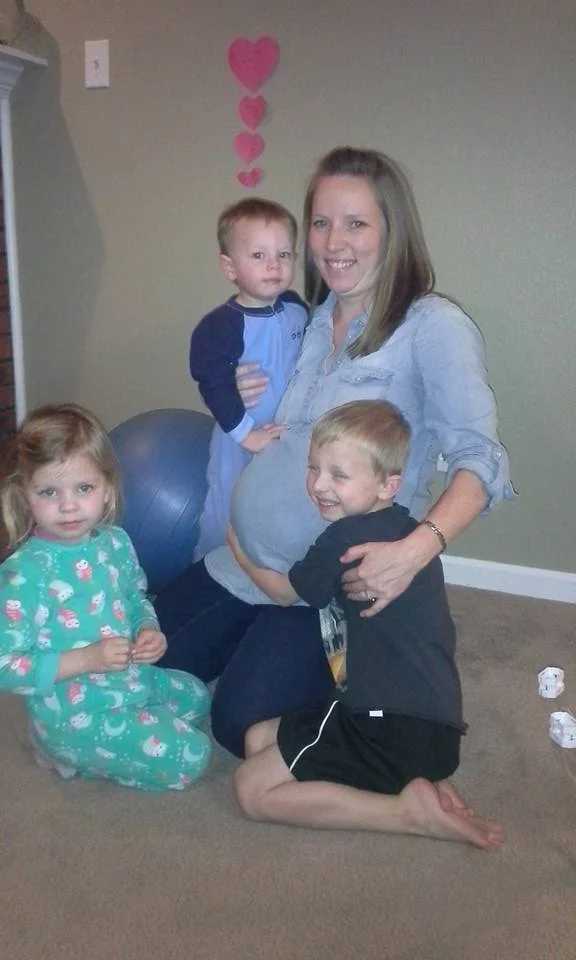
For the days to come I did squats and other exercises to get Londyn to move further down and push on my cervix to help it open up. Saturday rolled around (I was now exactly 41 weeks) and we attempted stripping my membranes again at 12:30pm. This time Alex was confident it would work, by the time she finished I was dilated to 6cm and 70% effaced and Londyn had moved down (my squats worked!), Alex even felt her ear while stripping my membranes. Alex said, “I think it’s going to work this time. I bet I’ll go home for lunch and be back in a couple hours.” She was right, this time it had jump started labor.
I began contracting 45 minutes later. The contractions were neither consistent, nor intense so I was hesitant to get my hopes up. Mom had taken our other three kids to lunch and I called her to bring them home since this was probably real labor and we’d get them to a babysitters. Like my previous births I was nervous contractions would stop and didn’t want to call Alex, get everyone here and then have it be false. So I kept putting the phone call off telling Paul, “Let’s just time them for a little longer and see if they regulate.” But based on our last 2 births that happened so quickly and without a doctor/midwife present, my husband, Paul, insisted I call Alex and he was right to do so. I gave Alex a call and told her contractions were about 4-6 minutes apart, lasting 55 seconds and mild. She said she’d be on her way (it was about 1:30 by this time). Paul and I went for a walk to keep contractions going and when we got back everyone was here setting up (about 2:00pm now). We had Alex, her assistant Sarah (a registered nurse) and another registered nurse, Elise, who mostly there to observe (this was her first time witnessing a homebirth), as well as Mom. I was impressed at their quickness to get to the house and start setting up, I was also relieved to know that this time around we’d have all our support team here and ready for the birth. I knew then that this birth would be much more relaxing and calm than our last few experiences.
Contractions slowly got more intense but weren’t getting closer together. This was different because in the past when I’ve started labor it has been text book: mild contractions to more intense and closer together, it’s also gone quickly. These were a bit irregular and I felt that they weren’t’ intensifying very quickly. Paul gave me a Priesthood blessing, my gratitude for a husband worthy of that power is deep. In the blessing he said my body would be able to do what my body was built for and that my mind would be strong, he also blessed that our baby would be health and strong. Those words and my faith gave me peace.
Although I really disliked standing while contracting, each time I sat on the exercise ball contractions would slow, so Paul and I walked around the house and backyard. It was the most beautiful day with the sun shining, birds chirping and perfect weather. We walked back and forth in the backyard, talking about where we could plant our garden and what yard improvements to make this spring. Each time I felt a contraction coming Paul would talk me through it as I leaned against his chest and breathed. Alex offered to give me black and blue cohosh to help get contractions consistent as well as Clary Sage oil to rub on my stomach and inhale. Every few contractions Alex would check baby’s heart rate. Londyn was handling contractions like a champ. About 2 hours into labor I was frustrated that this wasn’t going faster, I didn’t feel like contractions were very intense yet and I thought they should be by this time, based on my previous experiences. At one point Alex was sitting in front of me as I rocked on our exercise ball frustrated that contractions weren’t intensifying as quickly as they had with my other births and she said, “Amelia, this is what normal labor is like for most other women and your just used to it going fast.” It made me laugh, but she was right, I tried to refocus my frustration into more positive thoughts.
Alex and Elise put some Clary Sage oil on my hands and put pressure in between my thumb and index finger, a pressure point that is supposed to help encourage the bags of water to break. Although Paul and I were laboring together well Alex began rubbing my back, the touch was different and felt so good. It was also great to have her encouraging me with different phrases than Paul had used. I let my mind listen. I think having a woman’s voice was calming and encouraging. About 20 minutes (4:45pm) later while in the backyard my water broke during a contraction. At that point my body began to shake uncontrollably and I knew I was transitioning. This is when it gets hard. I was ready to get in the tub.
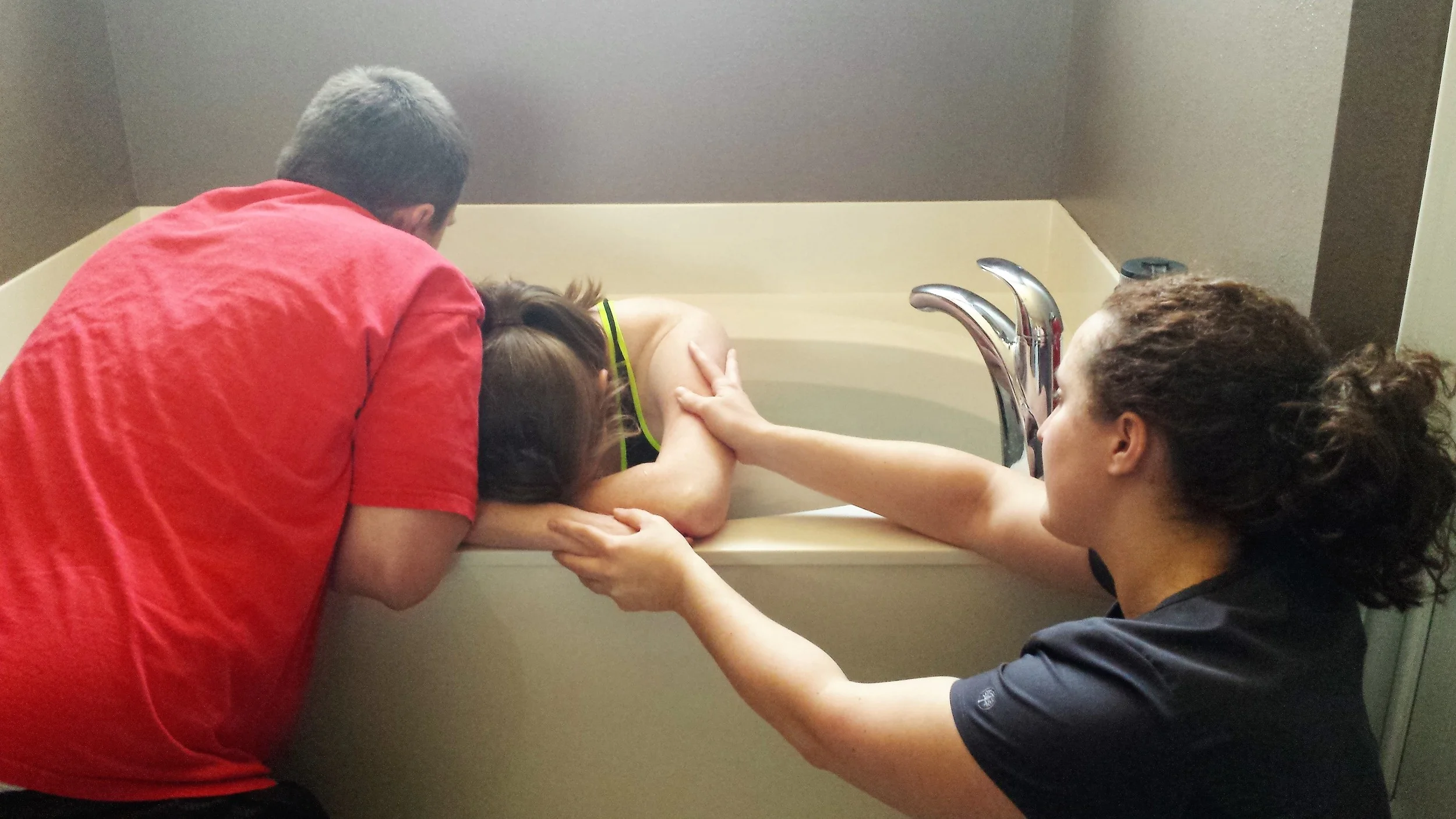
The tub felt so good! Our water heater had been wacky and although I would’ve like warmer water I knew I wouldn’t be in the tub long. I lay over the side of the tub and hugged Paul, cried and did my best to get through the roughest contractions yet. I listened to Alex’s encouraging words and her reminders to let my pelvis open up, relax and let baby descend. My body continued to shake but I didn’t try to hold the shakes back, I let my body relax. It’s incredible to feel all that’s going on during labor and birth. To feel my body do what it knows, what it was built to do. I love giving birth, I love being present and fully aware of what’s going on and also in full control. It really is so incredible! At this point I had another very intense contraction, about 5 seconds into the contraction I felt baby coming! Londyn, like Jameson and Grace (my previous 2 births), didn’t crown nor did we have any visual of her before this point. I could feel her head moving down. It was amazing! I was so much more aware this time instead of frantic and concerned about the lack of a medical provider being there. “She’s coming.” I told everyone as I moved to the back of the tub in preparation to catch Londyn myself. I reached down to feel her head coming out, as I kept my hand on her head I had a short time to take a deep breath and with the rest of the contraction her body slid out. “Catch her Amelia.” Alex said to me as I looked down and grabbed Londyn from the water and placed her on my chest.

She was here! And she was perfect! She let out an immediate cry as I held her on my chest and stroked her sweet tiny body. Labor was quick, approximately 4 hours from start to finish and the actual birth was just like Jameson’s and Grace’s, ending very quickly with just one contraction (she was fully born within 10 seconds), without pushing and no “ring of fire” burning.
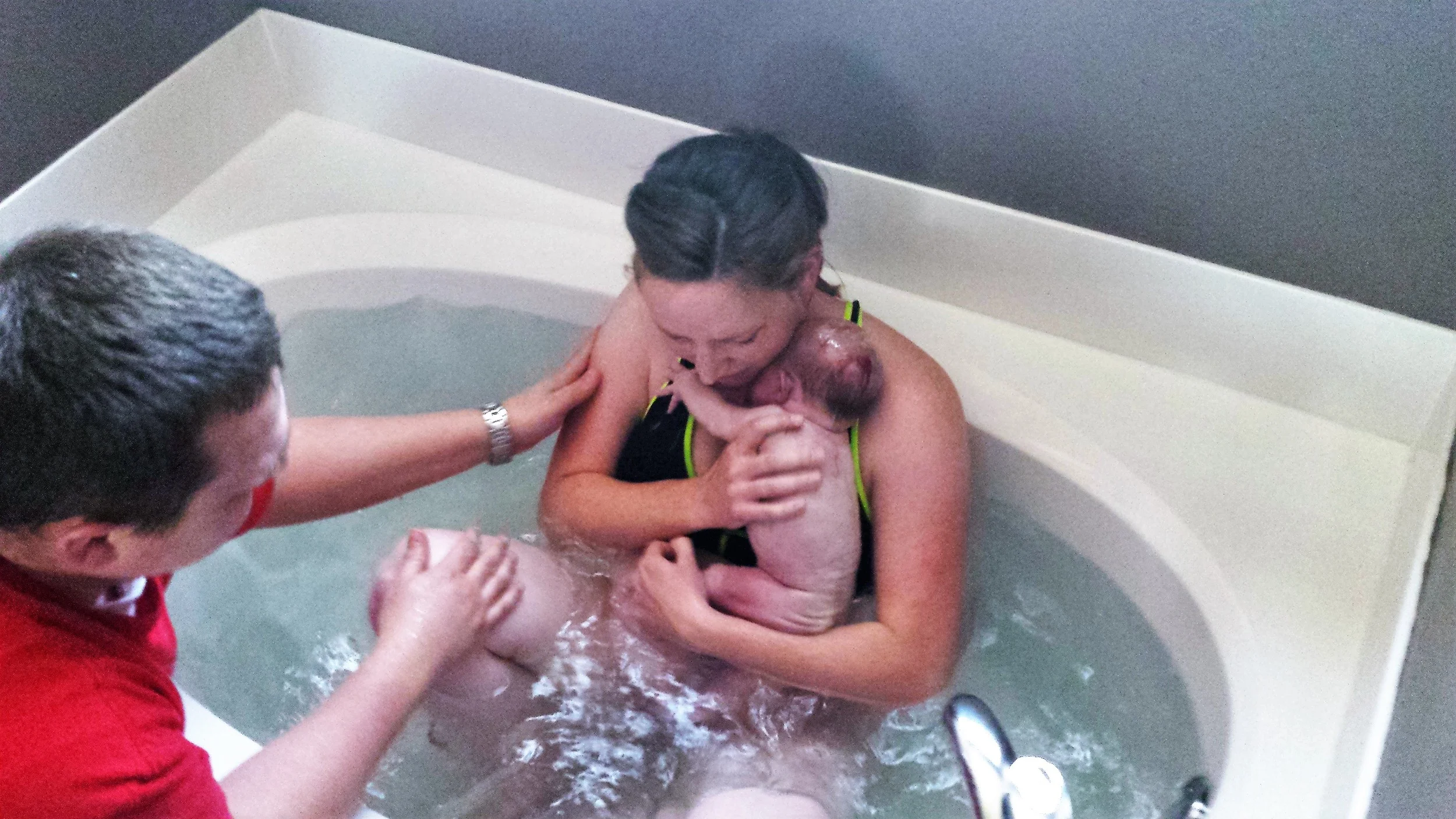
But with all the similarities, Londyn’s birth was also very different. I was so much more aware, I was calmer, I loved the help of my support group rubbing my back and giving me holistic options to help with labor which I’d never had before, I had supporters laughing in between contractions with me and making sure I drank my water and kept my body strong.

I’m so thankful the Lord blessed us with a successful home birth. He also blessed me with an able body to do go through such an incredible and empowering journey. I almost feel addicted to giving birth, it makes me feel so able and then I get to have this brand new life in my arms to care for, love and cherish for all eternity.

Childbirth Education Classes....Why do I Need Them?
Statistically, people do more research when buying a car than they do when having a baby...isn't that shocking?! I think childbirth education (CBE) classes are the equivalent to taking Driver’s Ed when you’re a teenager: 1) You take them because you want to and should know what’s going on within the “vehicle”, 2) So that you learn how to take action to make appropriate decisions, and 3) So that you don’t have regrets after the fact if things don’t go your way. But what type of CBE class should you take? Where should you take them? When should you start? What will the classes discuss? Do you need to take them if you already took CBE classes with a previous pregnancy or if this is your 2nd, 3rd, 10th child? What happens if you don’t take them? Keep reading if you want to find out…
Statistically, people do more research when buying a car than they do when having a baby...isn't that shocking?! I think childbirth education (CBE) classes are the equivalent to taking Driver’s Ed when you’re a teenager: 1) You take them because you want to and should know what’s going on within the “vehicle”, 2) So that you learn how to take action to make appropriate decisions, and 3) So that you don’t have regrets after the fact if things don’t go your way. But what type of CBE class should you take? Where should you take them? When should you start? What will the classes discuss? Do you need to take them if you already took CBE classes with a previous pregnancy or if this is your 2nd, 3rd, 10th child? What happens if you don’t take them? Keep reading if you want to find out…
What types of CBE classes are there? What are the differences between them?
There are many different types of CBE classes and while they all have similarities, they have differences too. Some of them are strictly for knowledge of the process of birth, while others get into pregnancy and postpartum. There are classes that are better suited for those birthing outside of a hospital setting, and those where it is more tailored for hospital delivery. Here are some of them, and a little bit about each so you know where to start in finding the one right for you:
- Bradley: This is the “husband-coached” method of helping to connect you and your partner, while giving him the tools to support you and be your advocate.
- HypnoBirthing / HypnoBabies: These methods use hypnosis and relaxation techniques to keep the mind and body calm throughout labor and birth, with a focus on relieving pain and discomfort.
- Birth Boot Camp: Focuses on natural childbirth and breastfeeding, in a contemporary manner.
- Birthing from Within: A spiritually-focused approach to birth and parenting, based on the book Birthing from Within by Pam England.
- Lamaze: This method has been around since the 1950s and has changed from just the breathing (hee-hee-hoo panting) that we all know, into a well-rounded natural childbirth course.
- Non-Specific Natural Birthing Classes: Many childbirth educators have created their own style of CBE that can be a combination of multiple methods or a creation of the educator’s own making.
- Hospital-Based Classes: These are the classes held at and usually taught by someone affiliated with the hospital (whether on staff or independently hired). While they can have some information about natural childbirth, the majority of the class is usually about medications, procedures and an overview of the birth process.
Where should I take my CBE classes?
Many CBE classes are held at offices, birth centers, hospitals, or even in the instructor’s home. My word of advice would be though, if you’re wanting a natural childbirth with as few interventions as possible, take a class that is not affiliated with a hospital, even if you plan to have a hospital birth. Most of the hospital-based classes I’ve witnessed are focused less on giving you unbiased information so that you can make an informed choice, and more on teaching you on how to be a “good patient” when you arrive in labor.
When do I need to start taking CBE classes?
The answer to this really depends on what type of class you want to take. For people interested in Bradley classes, I recommend starting in your 2nd trimester since there are more sessions in this class and you want to be done with them all before you go into labor. If you are planning on taking a class with fewer sessions, that buys you more time before you have to get started. Overall though, I think it’s a good idea to be taking a class soon after starting your 3rd trimester, if not before. That way you can benefit from practicing the labor support techniques, breathing exercises, massages (who doesn’t want to have massages practiced on them?!) and relaxation exercises before going into labor.
What will my CBE class discuss?
It really depends on which class you’ll be taking. Some will focus more heavily on labor support measures and techniques while others will be more information-driven. All of them though should discuss the following topics (if they’re not hospital-based):
- Benefits of natural birth
- Labor support measures and techniques to help you manage discomfort or pain
- Process of labor, including early, active, pushing and immediate postpartum phases, and what to expect along the way
- When to call your care provider if you’re in labor
- Benefits/risks of medications and procedures
- Creating a birth plan
- Breastfeeding
If I took a CBE class before, do I need to take another?
I get asked this question a lot by moms who have already had another child. The answer is, it kind of depends on you. Has it been a long time since your last class? Do you still remember what you learned? Do you want to try a different type of class to learn alternative labor support techniques? Some moms will also just take a “refresher course” with their past CBE instructor to help remind them of things they’ve forgotten or they’ll reread the text book that they received from their past class.
What happens if I don’t take a CBE class?
I’ll throw you in jail and take your sweet baby for myself! Nah, just kidding! ;-) Nothing happens if you don’t take a CBE class, and that is both good and bad. You’re not out the time and expense of a class, but you’re also not reaping the benefits of one. Moms who take CBE classes and educate themselves have a much higher likelihood of experiencing the birth that they want and feeling more satisfied about their birth outcome. They’ll know what to expect during labor and birth, as well as things they can do to cope, and the information they’ll need in order to make informed decisions for themselves and their baby.
In the end, yes, your baby will still be born (you won’t be pregnant for forever!). Taking a CBE class doesn’t change that, but what it does do is to help shape how you get there. When you’re driving on a road trip, eventually, you’ll still reach your destination, but what type of journey do you want to have? If you have constant car trouble, get lost numerous times, or are unable to stop along the way to enjoy life’s blessings, wouldn’t it affect your overall experience and the way you look back on the memories from it?
Knowing Your Options & Creating a Birth Plan
Did you know that the average couple spends more time researching what car to lease or what house to buy than they do preparing for the birth of their child? Don’t be a statistic! Learn about your options so that you can make the best decisions possible regarding your pregnancy, birth and the start of your baby’s life. In doing so, you can use these options and the ones that are important to you, to create a birth plan to share with your care provider and your doula to make sure you all are on the same page (and if you’re not, it’s time to think about finding someone who is). Here are some choices you have that you may have never thought about or known were choices before…
Did you know that the average couple spends more time researching what car to lease or what house to buy than they do preparing for the birth of their child? Don’t be a statistic! Learn about your options so that you can make the best decisions possible regarding your pregnancy, birth and the start of your baby’s life. In doing so, you can use these options and the ones that are important to you, to create a birth plan to share with your care provider and your doula to make sure you all are on the same page (and if you’re not, it’s time to think about finding someone who is). Here are some choices you have that you may have never thought about or known were choices before…
Pregnancy
- Care provider
- Midwife, nurse-midwife or doctor?
- Setting of prenatal visits
- In your own home, or at an office or birth center?
- Can the time/day be when it is convenient for you and your partner or do you have to change your schedule to fit your provider’s?
- Length of prenatal visits
- How much time would you like to be able to spend with your care provider? 5 minutes, 30 minutes or as long as you need?
- Laboratory testing (blood and urine)
- Are you giving your consent and is your provider explaining what each test is for? Are you being given your options or just being told that you need to do something?
- Ultrasounds
- Are you having ultrasounds recommended to you only when they are necessary or at each visit to measure “size of baby”? (Side note: ultrasounds in the 3rd trimester can be off by up to 1-2 pounds when it comes to measuring the size of your baby, so don't let this be the only reason why someone suggests an induction)
- Vaginal exams
- Rarely are they medically necessary prenatally, so are you requesting one or is your care provider pushing for one?
- Is your care provider explaining their reasoning and asking your permission rather than just telling you to strip?
- Induction
- Is your provider discussing induction when it is not medically indicated (ex: big baby, holiday/dinner/golf time approaching, etc)?
- How long will your provider "let" you go past your due date before wanting to induce?
- Connection with your birth team
- Do you feel everyone who will be at your birth is there for YOU and with YOUR best interests at heart?
- Do you have a relationship with your provider that makes you comfortable and excited to see them at each prenatal and at the upcoming birth?
Birth
- Location of birth
- Home, birth center or hospital….hopefully not in a car!
- Who you would like present for your birth
- See my other blog posting about who to invite to your birth
- Clothing
- Your own clothing vs. an issued gown
- IV
- Do you want a routine IV placed in your arm to provide fluids?
- Eating and drinking
- Did you know that most hospitals don’t allow moms to eat or drink in labor?! Who would have thought that was a “choice”? (And no, IV fluids are not the same thing when it comes to caloric intake and providing energy in labor, so don't let anyone fool you otherwise)
- Having your water broken ("artificial rupture of membranes")
- Ask about the benefits vs. the risks, and make the decision that’s right for you. Don't be afraid to ask for privacy to talk to your partner alone when making a decision.
- Freedom to move however you’d like in labor
- Would you like to lie down, walk around, be hands and knees, squat, etc?
- Intermittent fetal monitoring, instead of continuous monitoring
- This is very important if you want to be able to move around and have a better chance at an unmedicated or low-intervention labor and birth. (Side note: for moms who are higher risk, this might not be an option for you due to safety concerns for baby)
- Epidural
- While there are benefits to epidurals and they can be helpful tools in labor, they also carry risks and can create a spiral effect of interventions for your birth (ex: urinary catheter, continuous monitoring, episiotomy, vacuum extraction, c-section, etc). Be aware of the benefits and risks so that regardless of the outcome, you’re happy with your decision.
- Birthing position
- Shockingly enough, babies can be born without moms on their backs and their feet in the air! (Though you'll be hard pressed to find a doctor who will agree to any other position)
- Water birth
- Are you wanting to labor or birth in the water?
- Placenta
- Would you like to be able to see your placenta?
- Are you wanting to take it home to plant or encapsulate?
Baby
- Delayed cord clamping
- At time of birth, 30-40% of your baby’s total blood volume is still in the cord and placenta, so if your provider clamps the cord right away, your baby will be starting life on only 60-70% of the blood they should have had. (And this is important for all babies, not just premature ones!)
- Skin-to-skin
- Do you want to have skin-to-skin with your baby for a minute, 5 minutes, or over an hour? All initial newborn exams and evaluations (ex: APGAR score) can be done with baby on your chest, so unless you think your baby might grow several inches in the first little bit of life, probably okay to delay measuring and weighing baby to give you time to bond.
- Breastfeeding
- If you want to breastfeed, make sure no one will be giving your baby a bottle of formula/sugar water, or a pacifier
- Vitamin K
- Do you want your baby to receive injectable, oral or no vitamin K treatment? Definitely do your research as there are benefits and risks for all 3 options.
- Erythromycin eye ointment
- Does your baby need it? (ex: you currently have Chlamydia or Gonorrhea, or could possibly have contracted from your partner it without your knowledge)
- Can it be delayed so that baby’s sight isn’t impaired during that crucial first hour of bonding?
- Hepatitis B vaccine
- Does your baby need it? (ex: you’re going to be getting your child tattooed or allowing them to swap fluids with someone who has Hep B, you probably want to get it ;-) )
- Can it be delayed or does it have to be given within a day or two of birth?
- Rooming-in
- This is when baby stays with you the entire time instead of being taken into another room or to a nursery.
- Circumcision
- Research both sides of the argument and inform yourself before making a decision either way. I always recommend my clients read articles that are both pro- and anti-circumcision to see which resonates with them, as well as watching a video on how the procedure is done so you can be prepared if you choose to do it. This is a very big decision for your son and you don’t want to make lightly.
- If you choose to circumcise, can it be delayed until baby is a week old so that there are fewer risks involved? (ex: hemorrhage, breast aversion, etc)
- Bathing your baby
- Do you want your baby bathed soon after birth? At 6 hours, 1 day, 2 days, or 1 week? There are benefits to allowing the vernix time to soak into your baby's skin, rather than being washed off. Also, soaps can be very drying to sensitive skin.
- Who would you like to bathe your baby? (ex: care provider, nurse, father of the baby, you, etc) Keep in mind, who do you think will bathe your baby more gently?
There is so much to learn about pregnancy and birth, and I understand it can be very overwhelming for parents to have to consider everything and make so many decisions. You may think ignorance is bliss, and want to leave all the decisions up to your care provider to decide what is best for you, but don't do it! If you don’t know where to look to find information, or want to learn more about something, reach out! Contact someone who does know about these things and have them point you in the right direction. You can contact your care provider, child birth educator, doula, La Leche League member, or even me! Regardless, whether you make the decision or you let someone else do it for you, that is still you making a decision....make sure it’s the right one for you.